In the AEC industry, success is often measured one project at a time.
Win the pursuit. Deliver the project. Move on to the next opportunity.
This cadence creates momentum. It builds revenue. It reinforces a culture of execution. But over time, it can also create a subtle trap. Leaders begin to optimize for the next win rather than the long-term trajectory of the firm.
You can see it in leadership meetings. The conversation centers on the next pursuit, the next deadline, or the next backlog milestone. Attention stays anchored to what is immediately in front of the team. Decisions are made to keep things moving. Progress feels real.
But step back, and something is missing. The larger direction of the firm is not being actively shaped. The work advances, but the trajectory remains unexamined.
The issue is not effort. It is how the firm is oriented.
AEC firms operate in a world of finite projects, but leadership is an infinite game. This distinction has been explored by Simon Sinek in The Infinite Game, and it provides a useful lens for how leaders think about building organizations that endure.
The Trap of Finite Thinking in a Project World
Most AEC firms are built to win projects. That is the nature of the industry. Each project has a defined scope, timeline, and outcome. You win or you lose. You deliver or you fall short.
This structure naturally shapes how leaders think. It encourages a focus on short-term results, immediate opportunities, and visible wins. None of this is inherently wrong. In fact, it is necessary.
The challenge arises when this mindset extends beyond projects and into how the firm is led.
Leaders begin to treat the business itself as a series of finite games. Revenue targets become endpoints rather than milestones. Client wins become validation rather than part of a broader strategy. Decisions are made to solve immediate problems rather than to build long-term capability.
Over time, this creates tension. The firm may grow, but it becomes increasingly dependent on constant effort to sustain that growth. Teams feel stretched. Leaders carry more of the burden. Complexity builds quietly in the background.
The firm is winning projects but potentially losing traction on the game that actually matters.
Shifting to an Infinite Leadership Mindset
An infinite mindset reframes how leaders think about success.
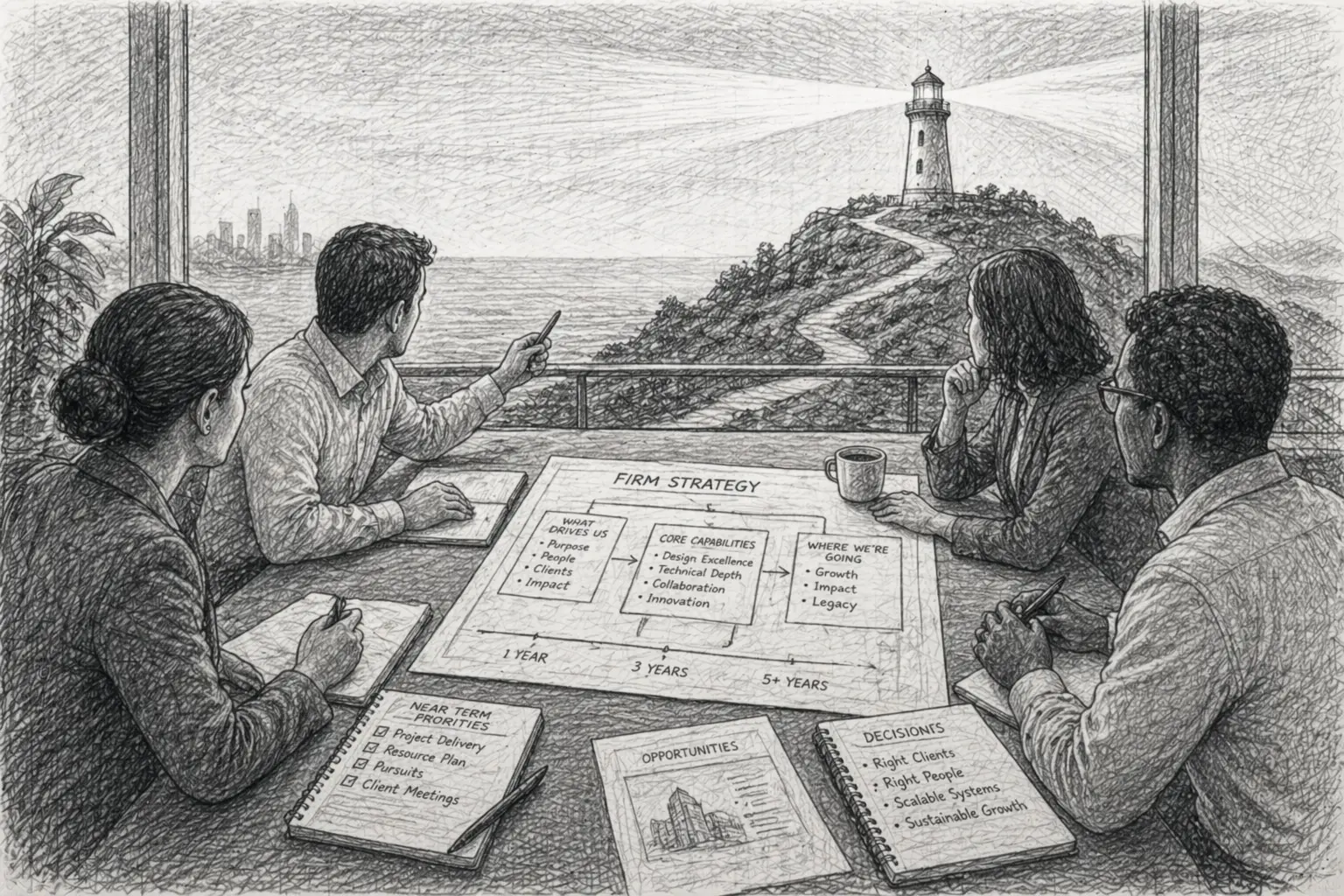
Instead of asking, “Did we win this project?” the question becomes, “Are we building a firm that can continue to win, adapt, and grow over time?”
This shift changes how decisions are made.
Client selection becomes more intentional. Not every opportunity is worth pursuing. The right clients are those who align with how the firm wants to operate and grow.
Talent development becomes a priority. Instead of solving every problem themselves, leaders invest in building people who can think, decide, and lead. Over time, this reduces dependency on any one individual and strengthens the organization as a whole.
Systems and processes are designed not just for efficiency, but for scalability. The goal is not simply to get through the next project, but to create repeatable ways of delivering value without increasing complexity.
An infinite mindset does not ignore short-term performance. It puts it in context. Each project becomes part of a larger trajectory rather than an isolated event.
Aligning Daily Actions with Long-Term Impact
The most difficult part of playing the infinite game is not understanding it. It is living it in the middle of daily demands.
AEC leaders operate in environments where urgency is constant. Clients need answers. Projects require attention. Teams look to leadership for direction. It is easy for even the most intentional leaders to get pulled back into short-term thinking.
The difference is not eliminating short-term pressure. It is consistently returning to long-term thinking in the middle of it.
Leaders who operate with an infinite mindset build simple practices into how they lead.
They create space for regular reflection, stepping back from the day-to-day to assess whether decisions are aligned with the long-term direction of the firm.
They reinforce priorities consistently, ensuring that teams understand what matters most beyond the immediate project at hand.
They make tradeoffs consciously, recognizing that saying yes to one opportunity often means saying no to another.
Over time, these small actions compound. The firm becomes more focused. Teams become more aligned. Growth becomes more sustainable.
The work still demands effort, but it becomes more intentional and less reactive.
Conclusion: Building a Firm that Endures
AEC firms will always operate in a project-driven environment. That will not change.
What can change is how leaders approach the work.
When leaders treat each project as part of a larger, ongoing journey, they begin to build something more durable. The firm becomes less dependent on individual effort and more capable of sustaining growth over time.
Leading with an infinite mindset is not about slowing down. It is about moving with greater clarity.
If you are ready to scale intentionally and build a firm that can grow sustainably with less complexity, more agility, and greater impact, let’s connect. Email me at info@odysseyadvisors.us, and let’s start doing simple better together.