As AEC firms grow, the most difficult leadership challenges rarely come from technical complexity alone. Engineering, architecture, and construction professionals are trained to solve problems, manage risk, and deliver projects. Yet as organizations scale, the most difficult obstacles often appear somewhere else entirely: within the leadership team.
Projects become larger. Decisions become more interconnected. The number of people involved in delivering results increases. In these environments, even highly capable leaders can find themselves struggling to stay aligned. Meetings become longer. Decisions slow down. Important conversations are postponed.
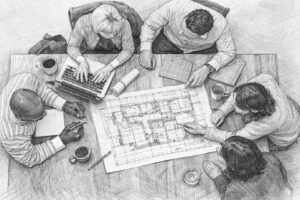
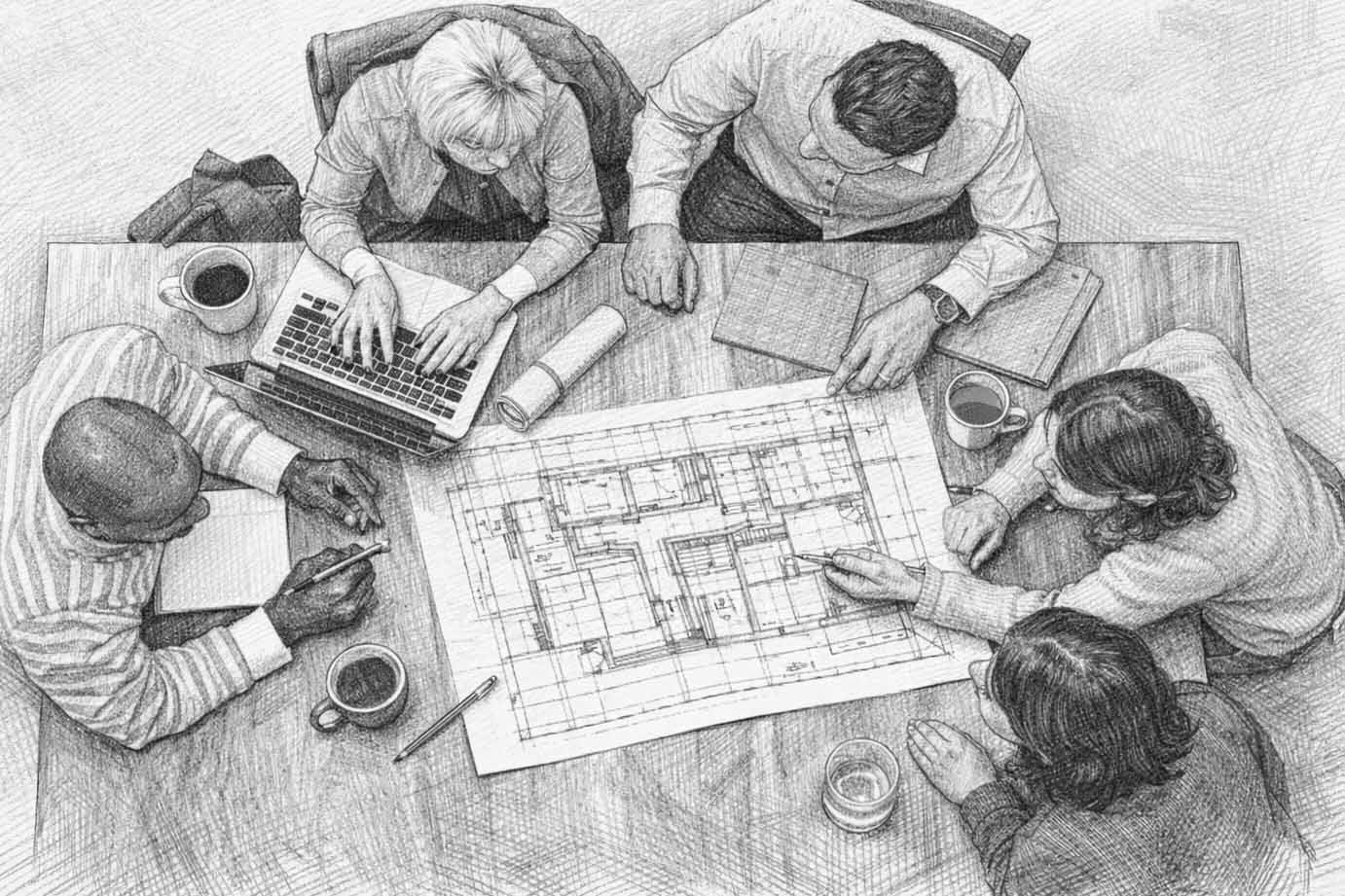
In many AEC leadership meetings, the conversation appears productive on the surface. Updates are shared. Heads nod. The meeting ends on time.
Yet when leaders leave the room, something subtle has happened. People walk away with slightly different interpretations of what was decided. The difficult issue was never fully addressed. Concerns that should have been raised remain unspoken.
Nothing is openly wrong. But nothing is fully aligned either.
A Common Pattern in AEC Leadership Teams
In many AEC firms, the leadership team is composed of highly capable individuals who have grown into leadership roles through technical excellence and years of project experience. Each leader carries responsibility for a major part of the business: engineering, architecture, construction, operations, or finance.
These leaders often work hard, care deeply about the firm, and respect one another professionally. Yet the leadership team itself may still struggle to function as a cohesive unit.
Meetings focus on updates rather than decisions. Difficult conversations are postponed in the interest of maintaining harmony. Leaders return to their departments and continue solving problems independently rather than collectively.
Over time, the leadership team becomes less of a decision-making body and more of a coordination forum between different parts of the business.
When this happens, growth becomes harder to manage. Decisions slow down. Alignment weakens. Leaders work harder, but the organization does not move forward as effectively as it could.
In my work with leadership teams across the AEC industry, I see this pattern far more often than most firms realize.
This pattern is not unique to AEC firms. Patrick Lencioni described many of the underlying dynamics in his well-known leadership book The Five Dysfunctions of a Team. When leadership teams struggle to trust one another, avoid healthy conflict, or fail to commit to shared decisions, performance suffers.
For AEC leaders navigating growth, these lessons are particularly relevant. Strong teams do not emerge automatically from technical excellence. They are built intentionally.
Trust Is the Foundation of Leadership Teams
The first challenge Lencioni identifies is the absence of trust. In many organizations, leaders operate carefully around one another, protecting their reputations and avoiding situations that might expose weakness.
In AEC firms, this pattern often shows up among technically strong leaders who have grown into management roles. They respect one another professionally, but conversations stay polite and controlled. Leaders share updates, but they rarely admit uncertainty, ask for help, or challenge assumptions openly.
In many firms, this dynamic is not driven by ego but by professional conditioning. Engineers, architects, and construction professionals are trained to present answers. Credibility is built through expertise and confidence.
But leadership teams operate differently from project teams. The most effective leadership teams are not those where every leader has the answer. They are the ones where leaders can openly surface incomplete thinking, risks, and uncertainties so the group can solve problems together.
Without trust, collaboration remains shallow. Leaders may agree in meetings but leave the room with different interpretations of what was decided. Problems that should be addressed early remain unspoken until they grow larger.
Trust in leadership teams does not mean lowering standards. It means creating an environment where leaders can speak honestly about risks, challenges, and mistakes without fearing that vulnerability will undermine their credibility.
When trust is present, conversations become more productive. Leaders share information earlier, solve problems faster, and support one another in delivering results.
Healthy Conflict Creates Better Decisions
When trust is absent, teams often avoid conflict. Leaders choose harmony over honest debate, believing that disagreement will damage relationships.
In reality, the opposite is usually true. Teams that avoid conflict often experience frustration later. Important issues remain unresolved. Decisions feel unclear. Team members commit only partially because their concerns were never addressed.
AEC firms frequently experience this dynamic when leaders come from different disciplines or business units. Architecture, engineering, construction, and development perspectives may all be present at the same table. Each brings valuable insight, but without open debate, the team risks settling on the safest option rather than the best one.
I often see leadership teams in AEC firms default to quick consensus rather than working through disagreement. Meetings move efficiently, but important perspectives remain untested.
Ironically, firms that pride themselves on rigorous technical problem-solving sometimes struggle to apply the same level of intellectual debate to strategic decisions.
Healthy conflict is not about argument for its own sake. It is about creating space for leaders to challenge ideas, test assumptions, and explore alternatives. When teams engage in this kind of dialogue, decisions improve, and commitment increases.
Leaders who model curiosity and respect during disagreement help create an environment where conflict becomes productive rather than destructive.
Commitment, Accountability, and Results Drive Performance
Many leadership teams in AEC firms are not actually functioning as teams at all. They are functioning as a meeting of highly capable individuals who each run their own part of the business. The engineering leader runs engineering. The construction leader runs construction. The architecture leader runs architecture. They come together periodically to exchange information and coordinate decisions, but the real work of leadership still happens inside their individual domains.
A true leadership team operates differently. It functions as a collective body responsible for the performance of the entire enterprise, not simply as a coordination forum between departments.
Until that shift occurs, the leadership team will struggle to move beyond coordination and into true collective leadership.
Trust and healthy conflict create the conditions for two other critical outcomes: commitment and accountability.
Leadership teams that debate issues openly are far more likely to commit to the decisions that follow. Even when not everyone agrees with the final direction, they understand how the decision was made and why it matters.
This clarity allows accountability to function properly. When expectations are clear, leaders can hold one another accountable for results without tension or ambiguity.
In growing AEC firms, this dynamic is essential. Leadership teams must coordinate across multiple projects, disciplines, and markets. Without clear commitment and accountability, initiatives stall and priorities compete for attention.
When these elements are present, teams move faster. Decisions translate into action. Leaders support one another in delivering outcomes rather than operating in isolated silos.
The leadership team is the operating system of the firm. When it functions well, the organization moves with clarity and speed. When it does not, complexity quietly takes over.
Ultimately, these behaviors lead to the top of Lencioni’s pyramid: collective results. In strong leadership teams, success is defined by the performance of the firm rather than the achievements of individual departments or disciplines.
One of the most important shifts strong leadership teams make is redefining what their “first team” actually is.
In many AEC firms, leaders naturally view their department or business unit as their primary responsibility. The head of engineering advocates for engineering. The construction leader focuses on construction. The architecture leader protects architecture.
While understandable, this dynamic can unintentionally create a leadership team composed of departmental representatives rather than enterprise leaders.
High-performing leadership teams make a different shift. They begin to see the leadership team itself as their first team. Their responsibility is no longer to advocate primarily for their function but to steward the performance of the firm as a whole.
When this shift occurs, conversations change. Leaders become more willing to make decisions that benefit the enterprise even when it requires tradeoffs within their own departments.
Conclusion: Leadership Teams Shape the Firm
Strong leadership teams do not emerge by accident. They require intention, structure, and a willingness to address the human dynamics that influence performance.
For AEC firms navigating growth, the quality of the leadership team often determines whether strategy translates into results. Technical excellence alone cannot carry the organization forward. Alignment, trust, and accountability are equally important.
In my work with AEC leadership teams, the technical challenges facing firms are rarely the true constraint on growth. The real constraint is often the ability of the leadership team to have the right conversations, make clear decisions, and hold one another accountable for the outcomes that follow.
When leadership teams function well, strategy translates into execution. When they struggle, even the best plans stall.
If you want to strengthen the leadership team guiding your firm through growth, let’s connect. Email me at info@odysseyadvisors.us, and let’s start doing simple better together.